
Original Publish date: June 03, 2008
The first coats of lacquer have cured so the Earthen Talladegas are ready to be colored. We always prepare the surface for color by applying a base coat of nitrocellulose lacquer to raise the grain and create “bite” for the finish. Our nitro is thin and it seeps down into the wood to provide adhesion. The first coat swells the grain and lifts any “fuzz” so that we can scuff it smooth when it dries. Then we put three more thin coats on, about an hour apart to allow the solvents to flash off. Then the whole thing cures for two days to make sure all the shrinking takes place before sanding, not after.
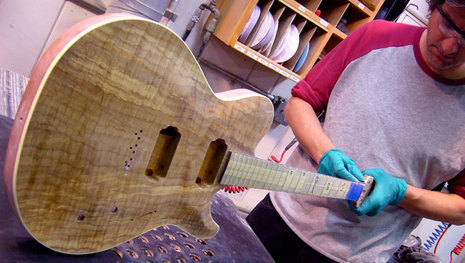

In this shot, Todd is sanding the first coats on the third day. We call this operation “leveling” because it is really more about getting the surface of the paint flat than just sanding. He’s using a 400 grit paper and a rubber block to get any peel out and give the color a perfectly flat surface to go down upon.
You can see the natural color of the earthen maple top as well as the mahogany back. By setting up the surface for color instead of staining directly into the wood, we’re able to create a depth to our colors that come from the fact that they actually “float” over the wood. It makes the burst appear “3D” when it moves in the light, something a stained top won’t do.